
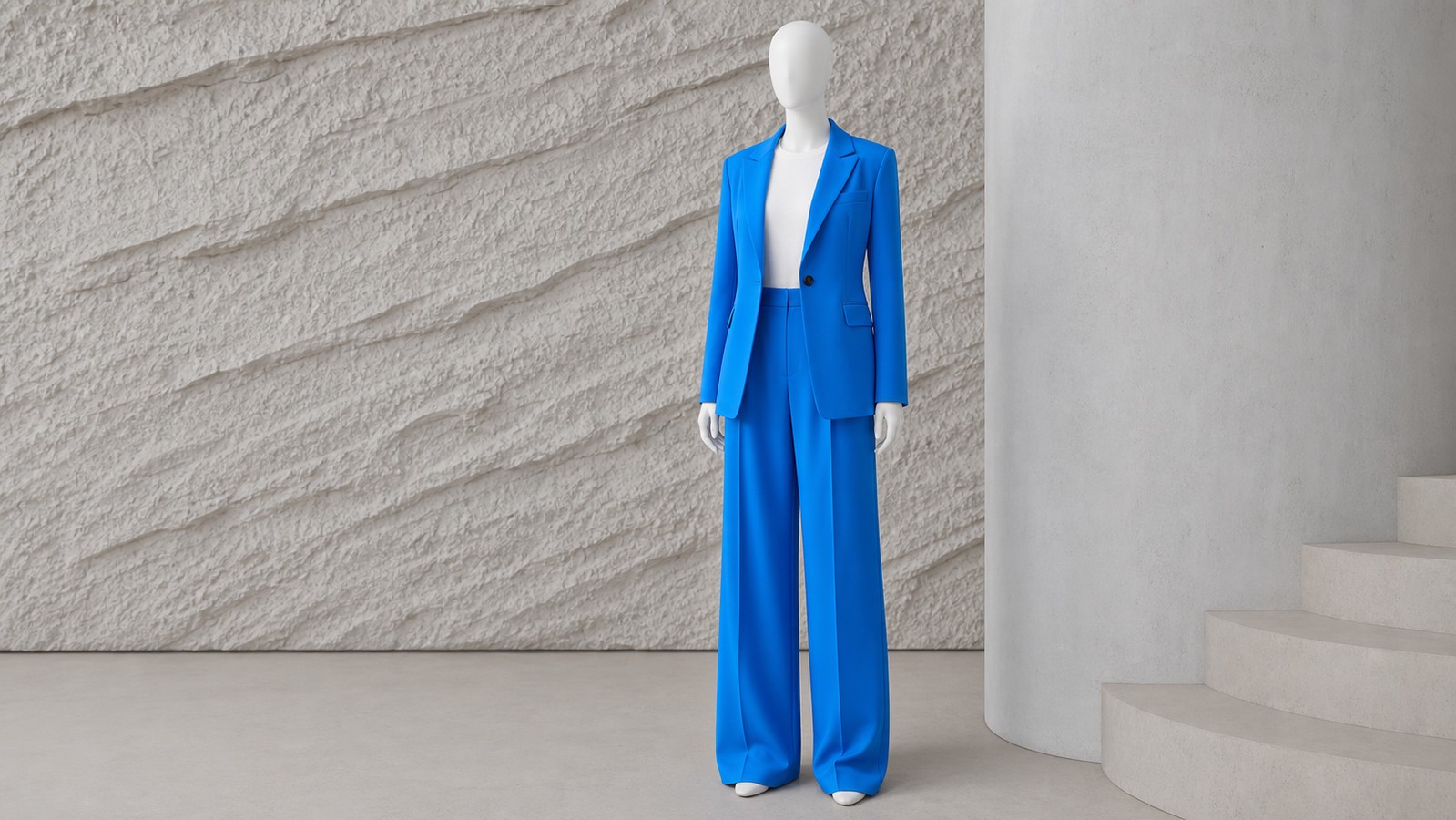
Contemporary tailoring earns attention when a familiar two-piece format carries a decisive design point. FROM ATTITUDE model CS2203TZ34 -1 pairs a structured blazer with high-waist, wide-leg trousers and introduces a geometric back cutout with a pleated drape effect. For fashion brands, wholesalers, and boutique buyers, the result is a statement set supported by published measurements, sample information, and defined production terms.
A Tailoring Statement for Focused Assortments
The product is presented as a two-piece blazer and trouser set for workwear, tailored assortments, and private-label or OEM/ODM sourcing. Its front view keeps recognizable suiting codes in place: crisp notched lapels, a single-button blazer closure, defined shoulders, and coordinated trousers. These elements give buyers an established category reference while the saturated electric-blue presentation supplies immediate visual impact.
The back treatment creates the strongest point of difference. The product page describes a geometric triangle cutout with a pleated drape effect, shifting the blazer away from conventional office tailoring and toward a more fashion-led position. That contrast can help a retailer frame the set as directional suiting, occasion-ready tailoring, or a standout coordinate within a broader collection. The product should still be evaluated through physical sampling for final drape, construction, and fit approval.
Design Architecture Buyers Can Review
Model CS2203TZ34 -1 combines several design features that are easy to discuss during assortment planning. The blazer uses strong shoulders and crisp notched lapels to establish its structured outline. The matching trousers use a high-waist, wide-leg shape and a floor-length proportion. Together, the two pieces balance a firm upper-body frame with a longer, flowing lower-body line.
A sourcing review should treat each visible feature as part of one coordinated silhouette. Shoulder shape, lapel break, blazer length, back-cutout placement, trouser rise, leg width, and finished length all affect the set as worn. The product listing provides a useful design starting point, while a sample gives the buyer the opportunity to examine these relationships on the intended body and confirm how the jacket and trousers work together.
- Blazer structure: strong shoulders, notched lapels, and a clean tailored front.
- Back detail: a geometric cutout combined with a pleated drape effect.
- Trouser shape: high-waist construction with a loose, wide-leg line.
- Set coordination: matching pieces designed to create one complete tailored look.
Published Material and Seasonal Information
The product specifications declare a woven material and a 100% polyester fabric composition. The listing also names the fabric type as velvet fabric, while the product highlights describe a premium-grade tailored fabric. These are supplier-published details, and buyers can use sampling to confirm the precise hand feel, surface, weight, stretch behavior, wrinkle response, and color appearance required for their market.
Spring and summer are the seasons listed on the product page. Seasonal placement, however, depends on a buyer’s geography, retail calendar, styling, and fabric expectations. A brand may review the set for fashion tailoring, event dressing, coordinated separates, or workwear with a directional edge. Material testing and a physical sample remain the appropriate steps for confirming whether the supplied construction aligns with the intended selling window.
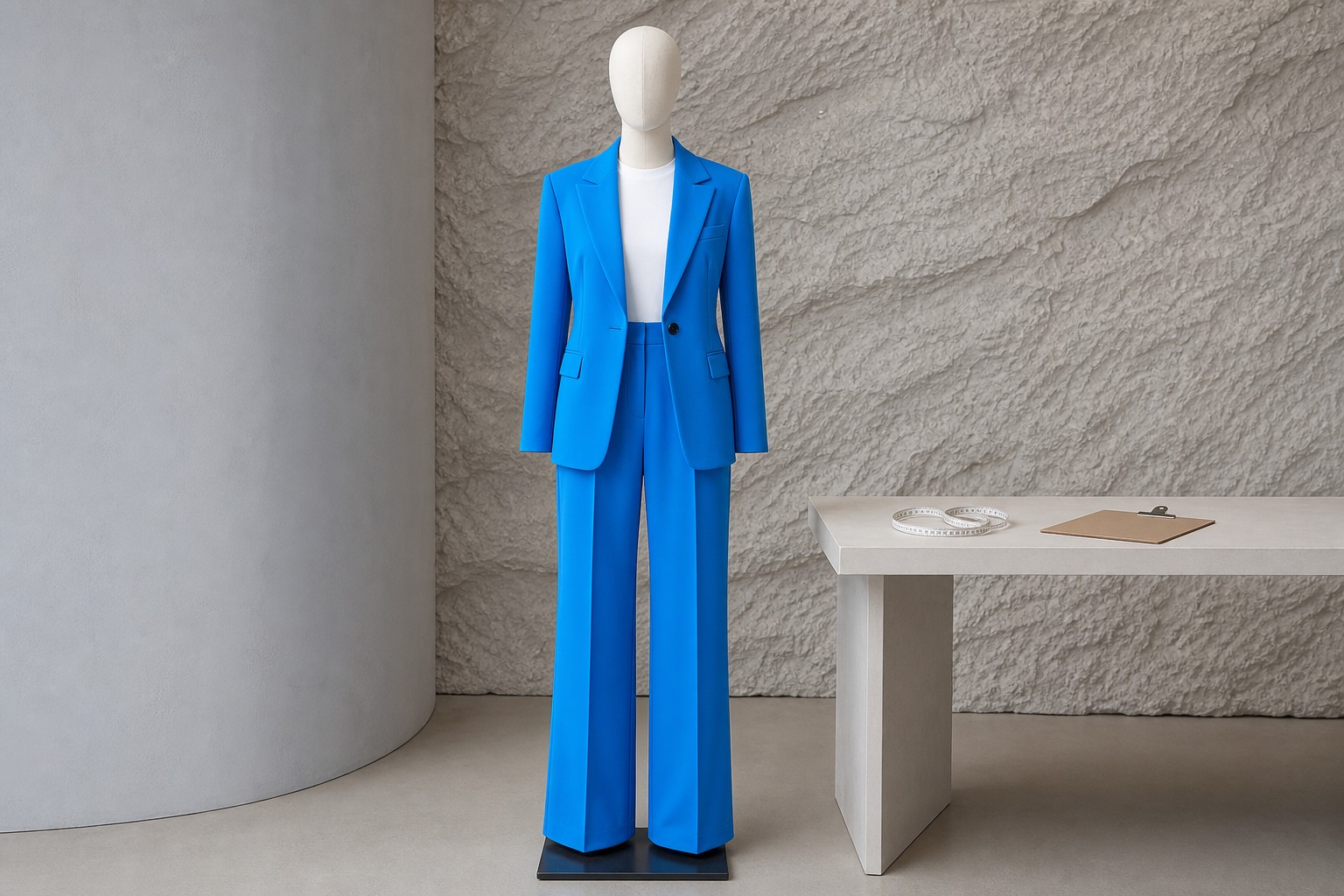
Measurements for an Early Fit Conversation
The published blazer chart supplies centimeter measurements for S, M, and L. Shoulder measurements are listed as 47, 49, and 51 centimeters; bust measurements as 93, 97, and 101 centimeters; sleeve measurements as 59, 60, and 61 centimeters; and blazer lengths as 70, 72, and 74 centimeters. These figures give sourcing teams a concrete starting point for comparing size progression across the listed entries.
The trouser chart also lists S, M, and L. Waist measurements are published as 68, 72, and 76 centimeters, with hip measurements of 98, 102, and 106 centimeters. Finished trouser lengths are listed as 108, 110, and 112 centimeters. Reviewing blazer and trouser measurements together is important because a coordinated set must satisfy upper- and lower-body fit requirements within the same size system.
The specifications separately state size availability of XS through XL with custom grading available. Because the visible chart provides detailed measurements only for S through L, buyers should confirm any additional grading requirements during development. Sample fitting can then address shoulder balance, bust ease, sleeve reach, back-cutout position, waist fit, hip ease, rise, and trouser length before the bulk-production size set is approved.
Sampling, MOQ, and Lead-Time Facts
The product page states that customized samples are supported and lists a sample time of 7–15 working days. Sampling creates a structured checkpoint between the online product concept and production. At that stage, the buyer can review design execution, garment balance, construction quality, measurements, material, color, and finishing against an approved requirement or tech pack.
The stated minimum order quantity is 100 pieces per style per color. This is a useful planning figure for buyers developing colorways or calculating a first production allocation. Final requirements should be confirmed directly for the selected configuration, especially when custom grading, labels, or other supported customization services are involved. A clear written specification helps both parties keep sample review and production discussions aligned.
The listed lead time is 25–35 days after sample approval. That timing is anchored to approval rather than initial inquiry, so a practical calendar should account for specification review, sample development, buyer feedback, possible revisions, and final confirmation before the production period begins. Shipping methods named on the page include DHL, EMS, UPS, FedEx, sea, and air, allowing buyers to discuss the delivery route that fits their order.
Private-Label and OEM/ODM Planning
FROM ATTITUDE lists OEM, ODM, custom-label, and private-label services for this product. Those service categories can support brands at different development stages, from selecting an existing direction for a branded range to discussing product adjustments within supplier capability. The listing also mentions custom grading, which may be relevant when a buyer needs a size architecture beyond the measurements shown in the published S–L chart.
A productive inquiry should identify the target market, intended size range, preferred color direction, quantity per color, labeling needs, and expected delivery window. Reference images alone do not replace specifications. Buyers can improve review efficiency by supplying measurement requirements, construction notes, artwork or label files where applicable, and a clear list of approval points for the sample.
For merchandising teams, the set can be evaluated both as a complete outfit and as coordinated separates. The blazer provides the strongest fashion detail through its back construction, while the wide-leg trousers support a recognizable tailored category. Retailers can consider how the pieces will be presented, styled, photographed, and grouped with complementary products, while keeping all claims tied to the verified product information and approved sample.
A Practical Buyer Review Checklist
Before confirming a development path, sourcing teams can translate the published details into a concise review sequence. This keeps visual preference, fit, customization, and commercial planning connected. It also helps separate details already stated on the product page from points that require sample inspection or direct confirmation.
- Review the front structure, back cutout, pleated drape, and trouser proportions against the intended assortment.
- Compare the published S–L blazer and trouser measurements with the target customer and grading plan.
- Confirm the declared material details, desired color, construction expectations, labels, and customization scope.
- Use the supported sample process to check fit, drape, finishing, and measurement accuracy.
- Plan quantities around the stated 100-piece MOQ per style per color and schedule around approval milestones.
Discuss Model CS2203TZ34 -1 with FROM ATTITUDE
Fashion brands, wholesalers, and boutique buyers can review the complete product listing, published measurements, and supplier-stated service details at the CS2203TZ34 -1 product page. Contact FROM ATTITUDE to discuss supported sampling, grading, OEM/ODM, custom-label, or private-label requirements for your planned assortment.