
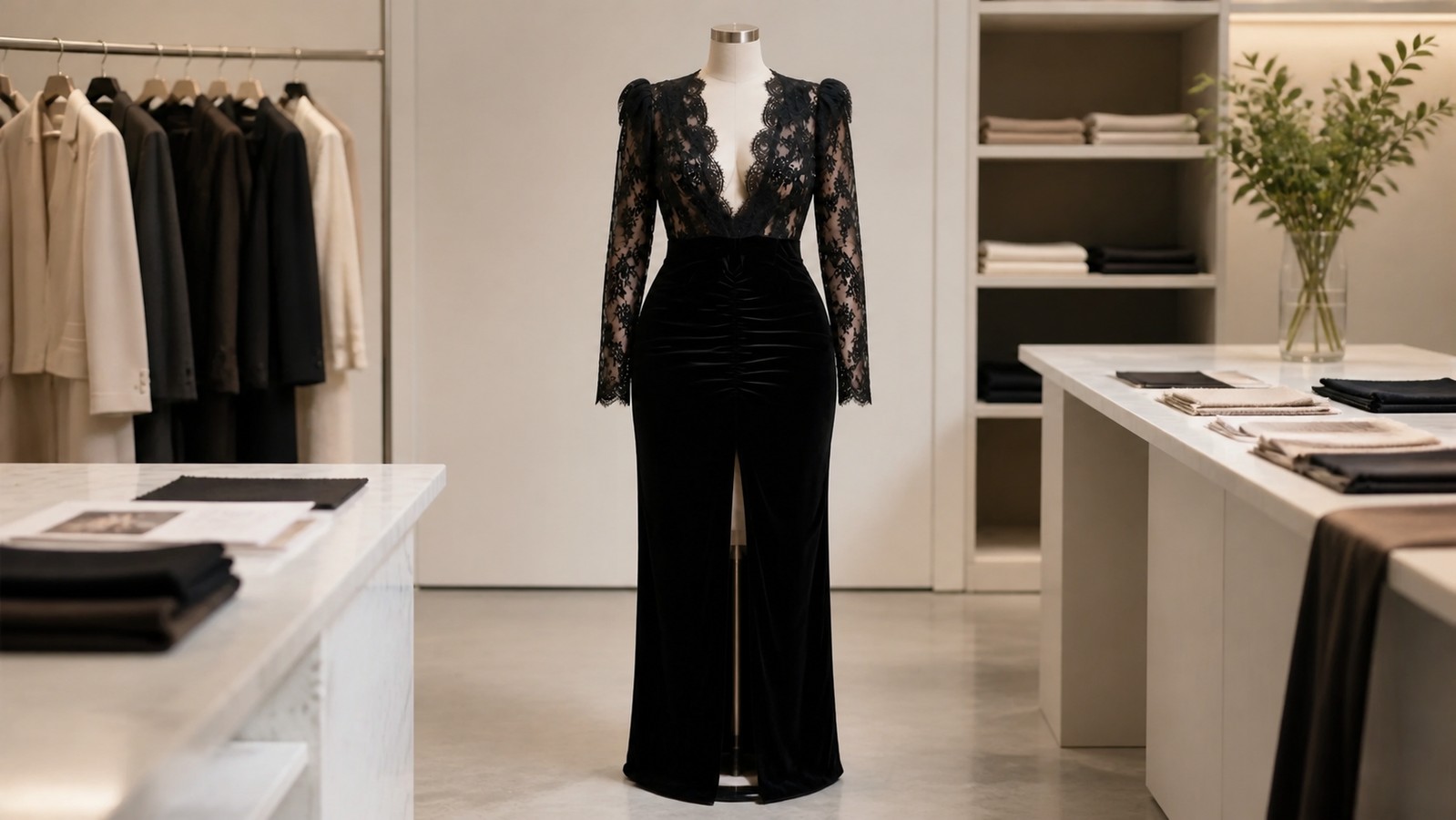
A plus size black lace velvet evening gown should be assessed through its verified construction, size chart, sampling terms, and intended occasion use.
Start with the verified garment concept
FROM ATTITUDE model ATT01 combines a sheer floral-lace bodice and long sleeves with a deep V neckline, a black velvet maxi skirt, and a front slit. The product page declares a 100% polyester composition and identifies lace and velvet as the fabric types. For a buyer, these details define the design proposition, but they do not replace a physical review of hand feel, opacity, stretch behavior, seam construction, or finishing.
Lace, neckline, and coverage
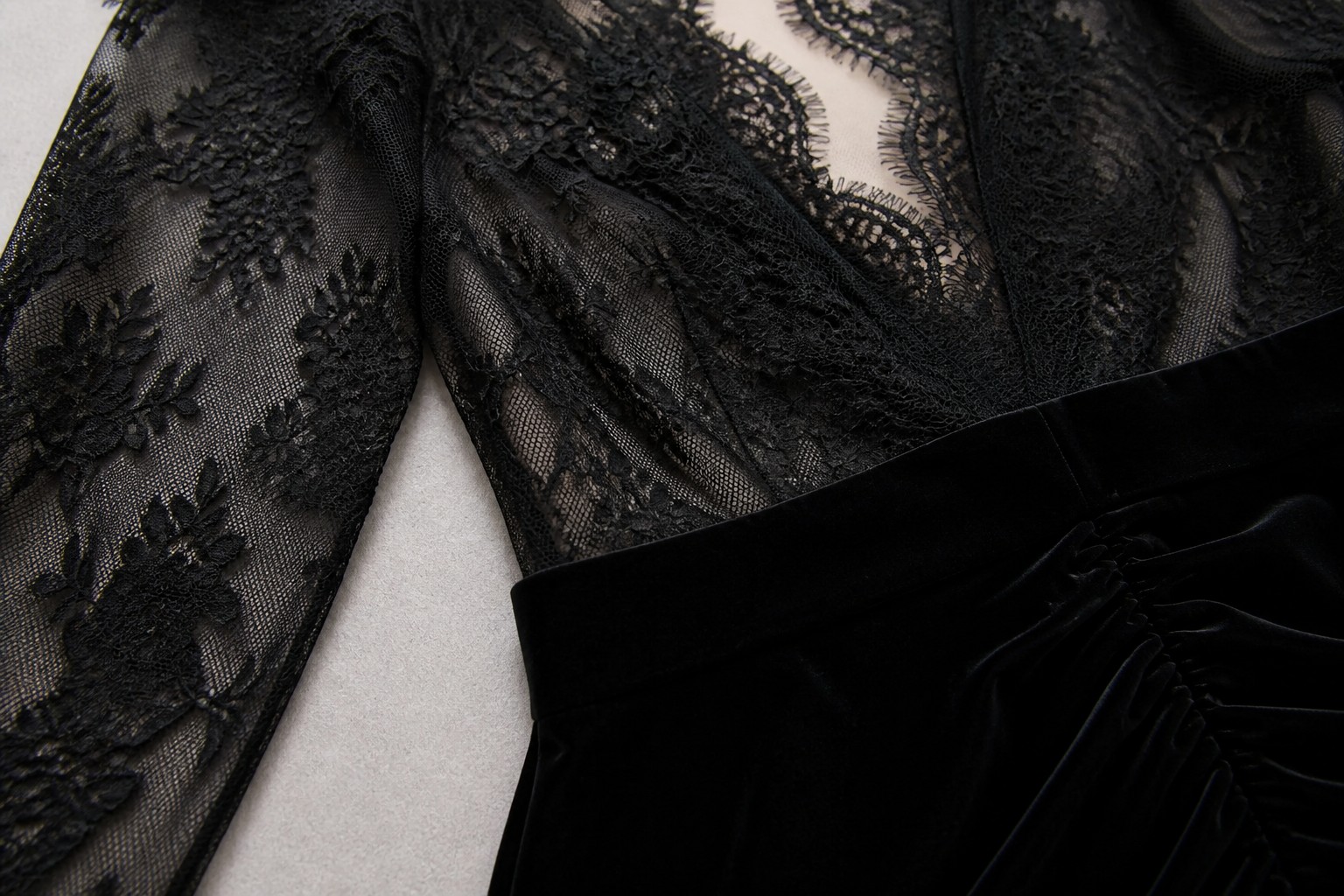
The page describes an elegant sheer lace bodice with visual coverage for curvy figures. The deep V neckline is a strong styling element, so a brand should define the intended neckline depth, bust support, undergarment strategy, and lace placement during sampling. The sample also needs a movement check at the shoulder, armhole, and sleeve because visual similarity alone does not establish comfort or range of motion.
Velvet skirt and front slit
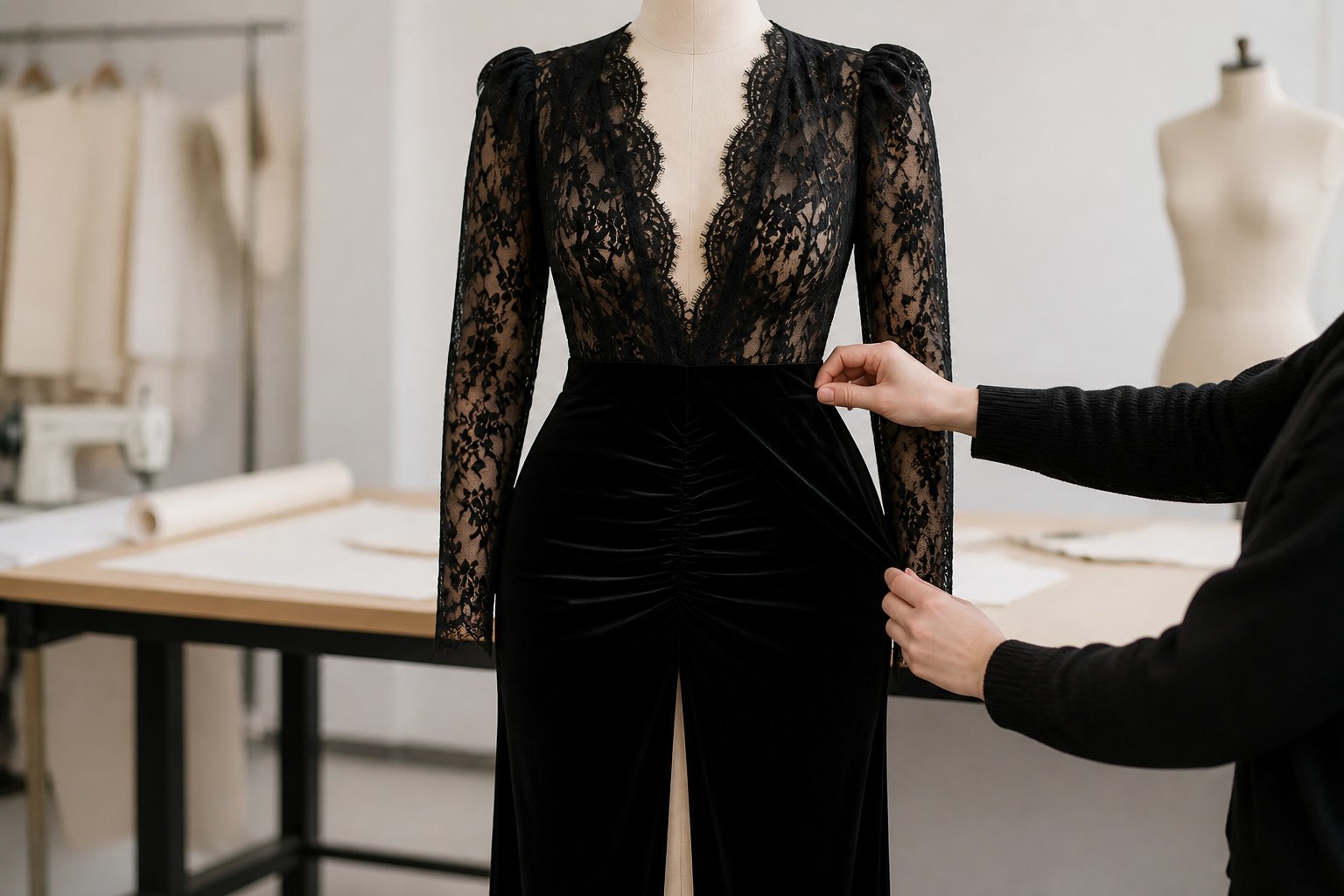
The velvet skirt is presented as soft-touch, draped, and suitable for extended wear. Buyers should translate that description into measurable approval points: surface direction, shade consistency, drape at the waist and hip, slit height, hem balance, and recovery after sitting. A plus size black lace velvet evening gown depends on the transition between lace and velvet, so the waist seam and the weight carried by each fabric deserve close review.
Read the size chart as garment data
The published chart provides garment measurements for XL, 2XL, and 3XL. It lists length, bust, and waist in centimeters and inches. These are useful production references, but they should not be treated as complete body-size guidance. ISO clothing-sizing work distinguishes body measurement definitions from garment measurement methods, which supports a practical rule: compare garment dimensions with the brand’s target-body profile and intended ease.
Check progression between sizes
Across the published rows, length moves from 135 cm in XL to 137 cm in 2XL and 139 cm in 3XL. Bust increases from 115 to 126 to 132 cm, while waist changes from 84.7 to 89 to 95 cm. The increments are not identical across every step. A buyer should confirm that the grading logic matches the target population, construction, desired ease, and the visual proportion of the lace and velvet sections.
Use a fit-review matrix
A fit review should record more than pass or fail. For each sample size, note neckline position, bust coverage, waist placement, sleeve mobility, hip ease, slit opening during walking and sitting, and hem clearance with the intended footwear. The product page states that custom grading is available, so any requested change should be documented as a controlled revision rather than an informal adjustment.
Place the style in a coherent assortment
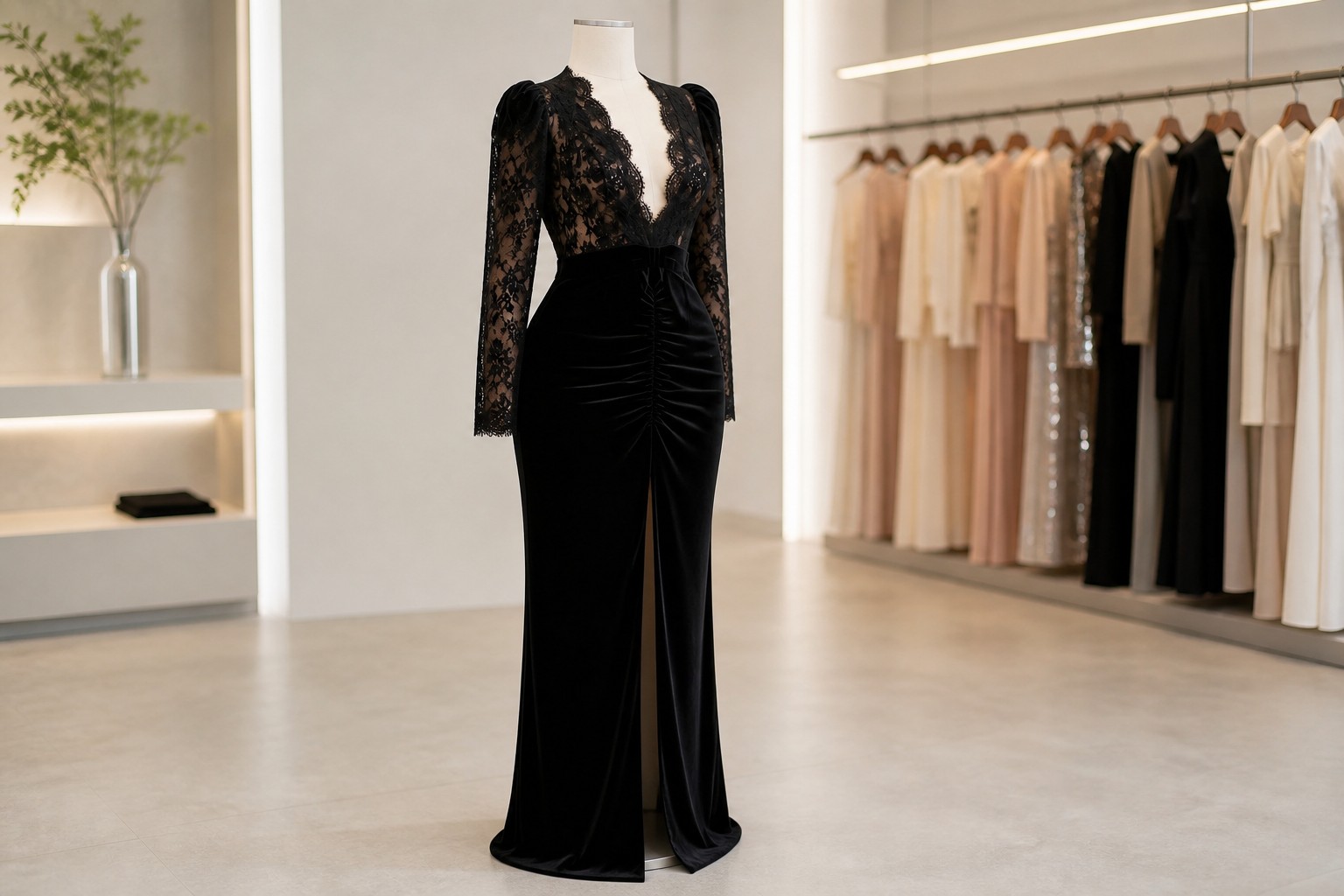
The page supports evening and occasion assortments and identifies formal parties and cocktail events in the product title. The black palette, lace transparency, velvet surface, maxi length, and slit create a defined occasionwear direction. Merchandising teams can use the gown as a statement piece, but the surrounding range should support the same customer, calendar, and price architecture rather than relying on an isolated visual.
Balance occasion and seasonal use
The specification table lists spring, summer, autumn, and winter, while the site’s merchandising evidence also supports cold weather assortments. Buyers should validate that broad season statement against the destination market, fabric weight, lining decision, sleeve transparency, venue type, and expected indoor or outdoor wear. Velvet may communicate cooler-season luxury, but the actual selling window depends on climate and the complete styled look.
Create useful retail information
Product information should clearly separate verified construction from styling interpretation. The stated fiber composition is 100% polyester, and the FTC Textile Fiber Rule illustrates why fiber names and percentages require careful label review for the U.S. market. Each buyer remains responsible for confirming destination-market labeling, care instructions, origin information, responsible-party identification, and any other applicable requirements before sale.
Control the sample-to-bulk pathway
The product page supports customised samples and states a sample time of 7–15 working days. It also declares a bulk lead time of 25–35 days after sample approval and an MOQ of 100 pieces per style per color. These figures give buyers a planning baseline, but production should begin only after the approved sample, size set, material standard, trims, labels, color, and quality checkpoints are clearly documented.
- Define the market brief: specify customer, occasion, season, target-body profile, intended ease, and retail presentation.
- Confirm materials: approve the black lace motif, velvet surface, polyester composition, shade, weight, hand feel, and any lining decision.
- Review fit: check the published measurements, requested grading, neckline, bust, waist, hip, sleeve, slit, and hem on appropriate fit models.
- Lock presentation: verify labels, tags, artwork, and packaging-bag requirements without relying on conflicting packing descriptions.
- Approve production controls: document tolerances, inspection points, shipment method, and the exact sample that authorizes bulk work.
The page lists OEM, ODM, custom labels, custom tags, and custom packaging bags. Those options support private label apparel sourcing, but each service needs a technical brief and an approval owner. A buyer should also confirm which timing assumptions begin only after sample approval and which inputs must be finalized before the clock starts.
Compare the sourcing evidence
A structured review keeps aesthetic appeal and production readiness in the same decision. The table below uses product-page evidence and shows the buyer action attached to each item. This evidence trail also gives merchandising, technical, and sourcing teams a shared basis for approval.
The review record can travel with the style from initial quotation through sample comments and bulk inspection. It should identify the document version, responsible reviewer, date, requested change, supplier response, and evidence of closure. Photographs are useful for placement and appearance, while measurements, test records, and signed specifications provide stronger control for repeatable production. If a buyer changes the neckline, sleeve, grading, fabric weight, trim, or packaging after sample approval, the revision should be assessed for cost, timing, fit, labeling, and quality impact before acceptance.
This disciplined record does not replace physical inspection, but it reduces ambiguity between commercial expectations and technical execution. It also helps a team separate a confirmed product-page fact from a request that still requires supplier agreement. Before bulk authorization, unresolved items should be assigned an owner and a completion date so the purchase decision reflects current evidence rather than assumptions.
| Decision factor | Verified evidence | Buyer implication |
|---|---|---|
| Design identity | Elegant sheer lace bodice, deep V neck, velvet skirt, front slit | Approve lace placement, coverage, drape, slit, and finishing on sample. |
| Published size range | XL, 2XL, and 3XL chart plus custom grading | Compare garment data with target-body measurements and fit intent. |
| Sampling | Customised samples; 7–15 working days | Confirm inputs, revision rounds, and approval criteria before scheduling. |
| Bulk pathway | MOQ 100 pieces per style per color; 25–35 days after approval | Align quantity, color, approved sample, and delivery plan. |
Frequently asked questions
Are the chart values body or garment measurements?
The product page presents them as a product size chart with length, bust, and waist. Buyers should confirm measurement points and compare the garment values with target-body specifications and intended ease.
What should be checked on the lace bodice?
Review motif placement, symmetry, transparency, neckline finish, seam strength, sleeve mobility, bust coverage, and the join with the velvet skirt. Record each point on the approved sample.
Does custom grading remove the need for fit testing?
No. Custom grading is a service option. A size set and appropriate fit models are still needed to evaluate proportion, ease, mobility, and the position of design details across sizes.
Can buyers request private-label execution?
Yes. The page lists OEM, ODM, custom-label, tag, and packaging-bag services. Buyers should provide artwork, placement, material, language, testing, and destination-market requirements for approval.
What does the bulk lead time depend on?
The stated 25–35 day period begins after sample approval. Quantity, finalized materials, grading, labels, tags, quality controls, shipping, and other agreed inputs should be confirmed before a buyer relies on the schedule.
Discuss Your Collection Requirements
Review the plus size black lace velvet evening gown against the target customer, fit profile, lace and velvet standards, size plan, label needs, and sample approval process before requesting a production quotation.