
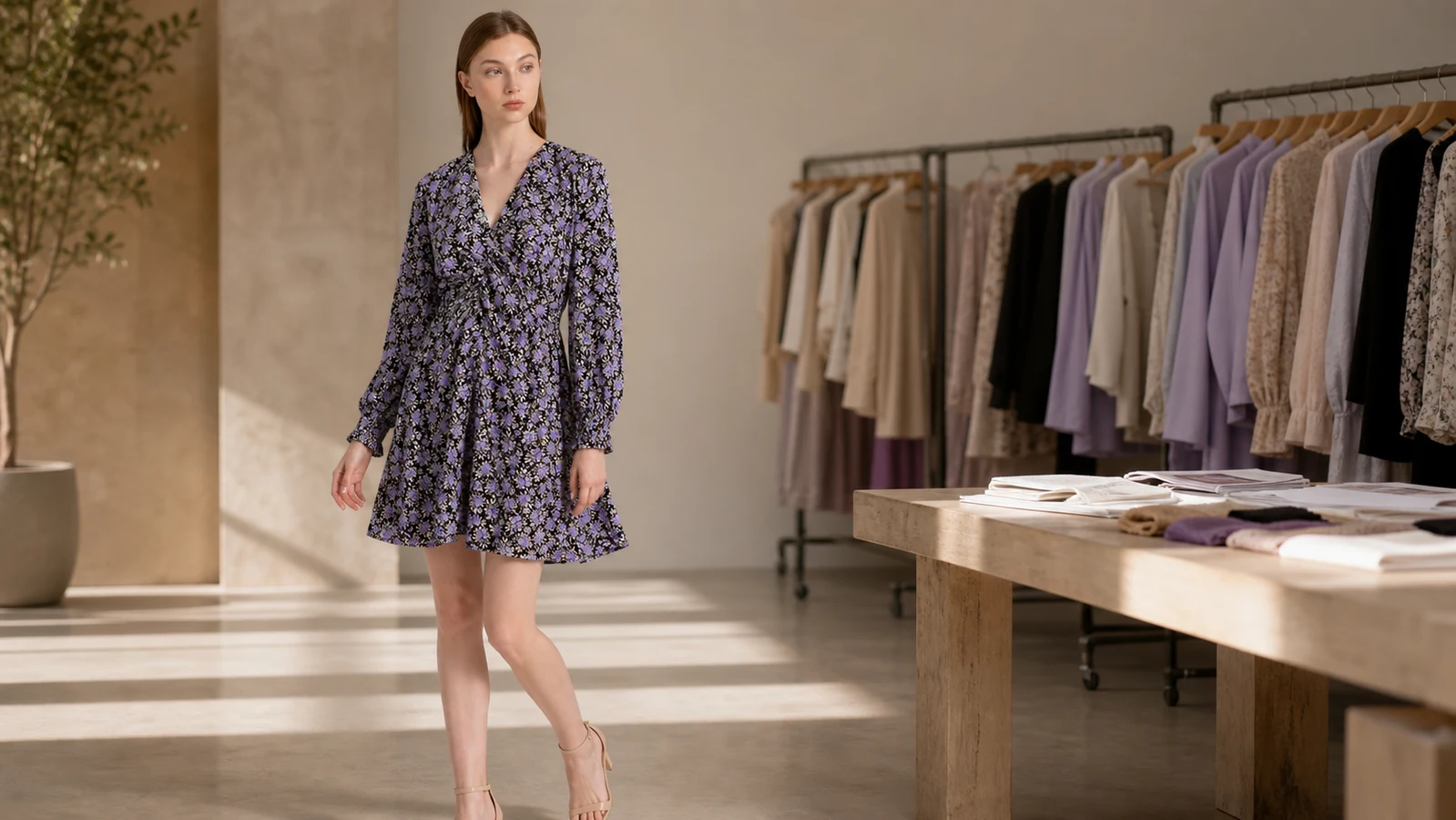
For assortment teams, a purple floral ruched v neck long sleeve mini should be reviewed through verified construction, sizing, styling, and sourcing evidence.
A successful sample review connects the appearance shown online with repeatable checkpoints for the physical garment. Model SS202219 provides a clear set of declared and observed details: a dark printed base with purple and lilac florals, a V-neckline, front ruching, long sleeves with smocked elastic cuffs, an elasticated back waist, and a short flared skirt. These details create the visual proposition, but each also gives the buyer something practical to inspect.
The published information identifies 100% polyester fabric, Spring and Summer positioning, sizes S through XL with custom grading available, and a measurement table for S through L. It also lists OEM/ODM support and customized samples. The best sourcing decision is therefore not based on an image alone; it comes from aligning silhouette, measurements, construction expectations, and intended retail context before approval.
Start With the Product’s Visual and Construction Logic
This style combines a close visual focus at the neckline and waist with movement through the skirt. The floral print carries most of the surface interest, while the ruching, gathered cuffs, and elasticated back create dimensional details. A buyer should treat those elements as one system. If the neckline, waist, or print placement is inconsistent, the product can lose the balanced appearance that makes the original concept useful for an assortment.
Review the Neckline and Ruching Together
The chic v neck ruched front should be checked for symmetry on a flat sample and on a fit form. Buyers can compare the left and right neckline edges, the point of the V, the direction of the gathers, and the transition into the waist. The relevant question is not whether every gather is identical, but whether the construction looks intentional, balanced, and stable across the planned size range.
Assess Print Character Without Inventing Color Claims
The verified description supports a dense purple and lilac floral pattern on a dark base. Sample approval can record motif scale, visible color balance, and obvious placement changes at major seams. Because screens, lighting, and production lots can affect appearance, a buyer should define the approved physical reference rather than promise an unsupported digital color match. That approach protects the concept while leaving room for an agreed production-control process.

Translate Published Measurements Into a Fit Review
A size chart is most useful when the team knows whether it describes body dimensions or finished-garment dimensions and agrees on measurement methods. The product table lists length, sleeve length, and bust values for S, M, and L. Those numbers offer a comparison baseline, but they do not replace a fit session, a measurement diagram, or an agreed tolerance sheet. The elasticated back waist also means ease and recovery deserve physical review.
Use Length and Bust as Repeatable Checkpoints
Published garment length progresses from 79 cm in S to 81 cm in M and 83 cm in L. Bust progresses from 88 cm to 92 cm and 96 cm. Buyers should confirm where each measurement begins and ends, then use the same method on every sample. This is especially important for a short dress, because a small change in measuring position can alter how the finished length is interpreted.
Check Sleeve Proportion and Cuff Recovery
Sleeve length is listed as 59 cm for S, 60.5 cm for M, and 62 cm for L. A useful sample check combines that measurement with cuff appearance, elastic recovery, and comfort on the intended fit form. The smocked cuff should return neatly after gentle extension and remain visually consistent with the sleeve volume. Any production tolerance should be agreed in the technical pack rather than inferred from the webpage.
| Size | Length | Sleeve length | Bust |
|---|---|---|---|
| S | 79 cm | 59 cm | 88 cm |
| M | 81 cm | 60.5 cm | 92 cm |
| L | 83 cm | 62 cm | 96 cm |
Build a Focused Sample Quality-Control Plan
For this purple floral ruched v neck long sleeve mini, quality control should follow the features that carry the design. The plan can begin with the declared 100% polyester printed fabric and move through neckline alignment, front gathering, waist elasticity, sleeve balance, cuff recovery, skirt shape, and measurement confirmation. Buyers should also agree on how appearance will be assessed after the care process selected for the final product.
Inspect Construction at High-Visibility Areas
The neckline point, ruched front, sleeve cuffs, and waist are visually prominent and mechanically active. Sample notes should identify puckering, uneven gathering, twisted seams, missed stitches, loose threads, and asymmetric placement. A simple photo record can show the approved front, back, cuff, neckline, and waist details. This gives the supplier and buyer a shared reference without turning natural fabric variation into an unrealistic requirement.
Separate Verified Facts From Approval Decisions
The webpage verifies fabric composition, listed measurements, seasons, and supported sourcing services. It does not establish the buyer’s final tolerances, care label, color standard, testing protocol, or inspection level. Those items should be documented during development. This distinction keeps the brief accurate: product facts describe the proposed style, while approval decisions define what the buyer requires for the intended market and order.
- Fit review: confirm neckline coverage, bust ease, waist position, sleeve length, cuff comfort, and skirt length on the intended fit form.
- Visual review: compare print balance, front symmetry, gathering, and the shape of the hem against the approved sample.
- Construction review: inspect seams, hems, elastic insertion, stress points, and finishing at the V-neck.
- Documentation: attach measurement methods, tolerances, labels, packaging choices, and any agreed tests to the production brief.

Position the Style in a Coherent Assortment
The dress can be evaluated for casual and everyday assortments because its floral surface, long sleeves, elasticated waist, and short skirt create an easy focal piece. Buyers can plan product-page imagery around the verified front and back details, while styling decisions such as footwear or outerwear remain separate from the product specification. This helps merchandising communicate versatility without implying unverified performance.
Use styling context to clarify the retail story. For workwear and tailored assortments, the buyer may test whether layering and accessories bring the floral print into a more structured presentation. For a softer everyday story, the gathered cuffs and flared skirt can remain the visual focus. These are merchandising possibilities, not product guarantees. The line plan should still account for local seasonality, customer preference, dress-length expectations, and the balance between printed and solid styles.
Connect development options to the technical brief. The supplier lists private label apparel sourcing through OEM/ODM services, custom labels, custom tags, custom packaging bags, custom grading, and customized samples. Each requested change should be written into the brief and checked for its effect on price, timing, fit, appearance, and minimum quantity. The declared minimum is 100 pieces per style per color, with a stated production lead time of 25–35 days after sample approval and a sample time of 7–15 working days.

Frequently Asked Questions
What fabric composition is declared?
The product page declares a printed fabric made from 100% polyester. A buyer can use that fact in the initial brief, then define any required hand-feel, weight, care, colorfastness, or appearance testing during sample development.
Which measurements are published?
The table provides garment length, sleeve length, and bust for S, M, and L in centimeters and inches. Buyers should request a measurement diagram and agreed tolerances so later checks use the same points and method.
Does the page support custom development?
Yes. The declared services include OEM/ODM, custom labels, custom tags, custom packaging bags, custom grading, and customized samples. The scope of each change still needs written confirmation for the specific project.
How should a buyer handle packaging information?
The scraped page contains conflicting packing descriptions, so this article does not select one as fact. The buyer should confirm the exact folding, inner bag, labeling, carton, and custom-packaging requirements directly in the order specification.
What should be approved before bulk production?
At minimum, approve the physical sample, measurements and tolerances, print reference, neckline and ruching appearance, cuff and waist elasticity, labels, packing method, testing plan, and the commercial terms that apply to the order.
Review the Style With a Clear Development Brief
For a closer look at the purple floral ruched v neck long sleeve mini and its verified sourcing details, visit the SS202219 product page and prepare questions around fit, construction, customization, sampling, and order requirements.