
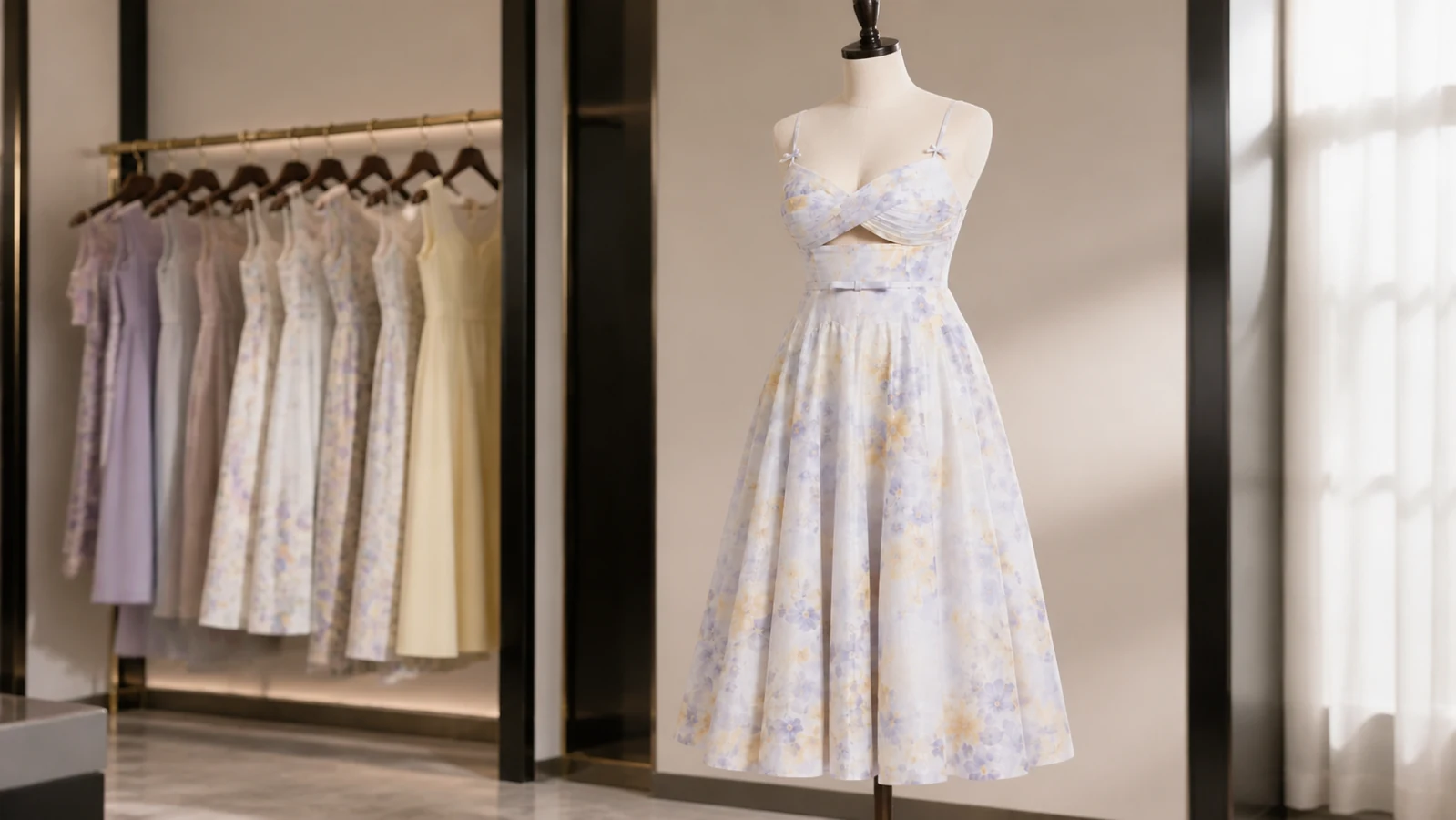
A floral print cutout midi dress should be reviewed for fabric, sizing, bodice construction, decoration, merchandising fit, and sourcing terms before approval.
Define the Product Evidence Before Sampling
The selected product page identifies model ATT13 as a printed cotton occasion dress with a twist bust, a subtle under-bust cutout, slender bow straps, a slim bow belt, and a pleated A-line midi skirt. Its pastel lavender-and-yellow watercolor floral pattern is presented for spring and summer, giving buyers a coherent visual direction for an initial sample brief.
Separate verified facts from visual assumptions
The declared fabric composition is 100% cotton, and the specification also names 3D flower decoration. Those statements can enter the request, but a photograph cannot establish fabric weight, weave density, opacity, shrinkage, colorfastness, reinforcement, or decoration durability. Each unlisted characteristic needs a sample test, a written specification, or both before approval.
| Decision factor | Verified evidence | Buyer implication |
|---|---|---|
| Product identity | ATT13 occasion midi dress | Keep the model linked to the approved sample and order. |
| Fabric | Printed fabric; 100% cotton | Test the production fabric against the approved hand feel and performance brief. |
| Season | Spring and summer | Align delivery, campaign timing, and fabric review with the target market. |
| Decoration | Declared 3D flower decoration | Confirm location, attachment, appearance, and care compatibility. |
Review Fit Data as a Sample-Control Tool
The published chart provides garment length, bust, and waist values for XL, 2XL, and 3XL. For example, XL is listed at 135 cm length, 115 cm bust, and 84.7 cm waist; 2XL at 137 cm, 126 cm, and 89 cm; and 3XL at 139 cm, 132 cm, and 95 cm. Buyers should confirm the measurement method before comparing increments or translating the chart into a target-market size guide.
Distinguish garment measurements from body dimensions
ISO 8559-2 describes clothing size designation in relation to body dimensions, while garment measurements include design ease and construction decisions. A buyer evaluating this floral print cutout midi dress should therefore document whether every chart value is measured flat, around the garment, or along a defined seam, then compare the physical sample with the intended body profile and desired wearing ease.
The product page also declares sizes from L through 5XL and custom grading availability. That range does not remove the need for a fit session. The sample review should cover strap length, bust containment, cutout placement, waist position, skirt volume, hem level, sitting comfort, movement, and the relationship between graded increments and the target customer.
Inspect Bodice, Bows, and Decoration
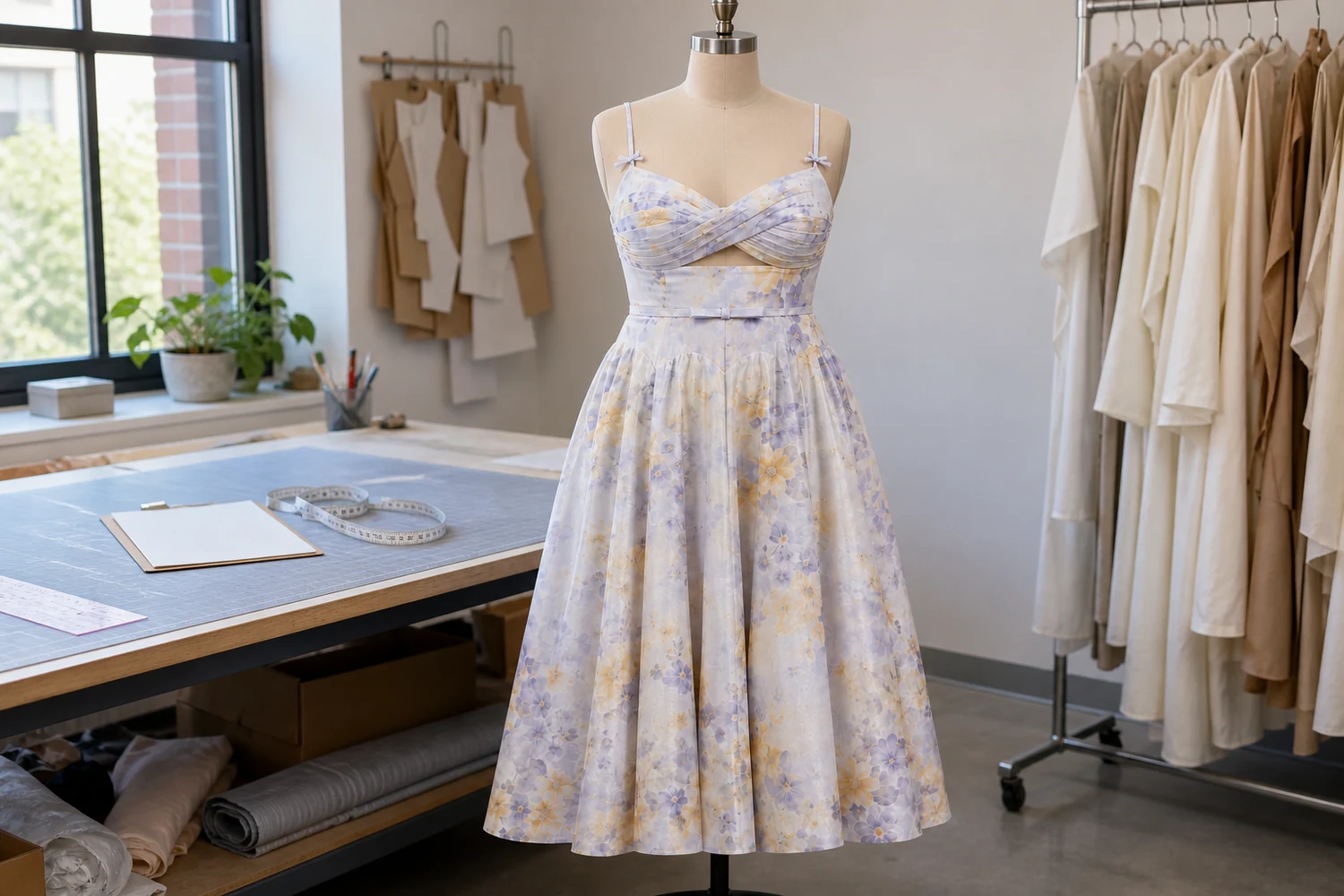
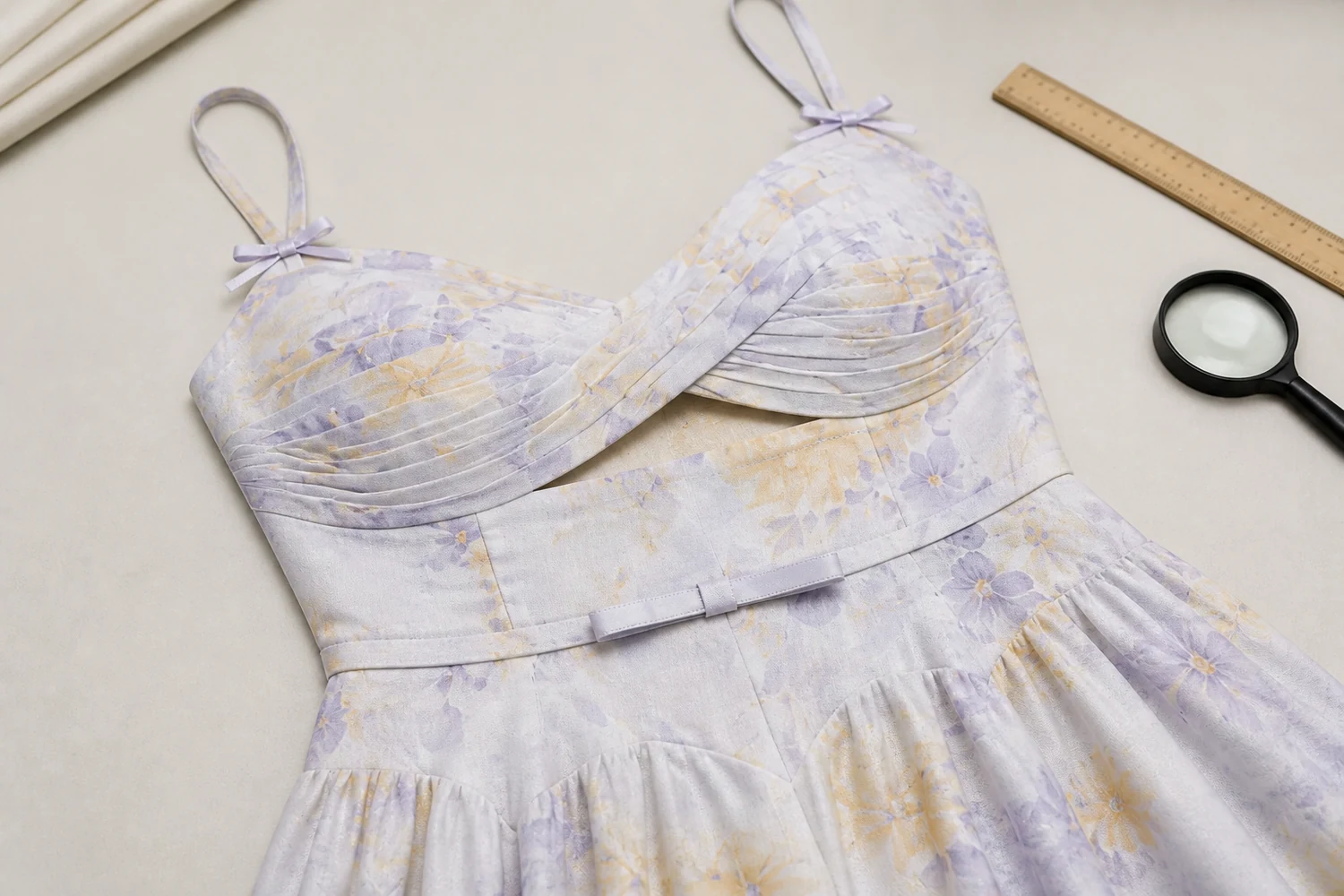
The charming cutout bodice is a central design feature, so its commercial success depends on repeatable balance rather than appearance alone. Teams can inspect symmetry at the twist, the shape and coverage of the cutout, stability at the upper edge, strap anchoring, seam smoothness, and how the bodice returns to position after normal movement.
Turn small trims into defined checkpoints
The delicate bow accents on the shoulder straps and the matching slim bow belt should be specified by position, finished dimensions, attachment method, and acceptable appearance. The declared 3D flower decoration also needs an approved reference because the page does not state its exact size, material, count, or placement. Production acceptance should not depend on an image-only interpretation.
- Bodice: check twist alignment, neckline shape, coverage, and support on the approved fit sample.
- Straps: check placement, length, attachment strength, and bow consistency.
- Waist: check seam position, belt alignment, and skirt transition.
- Decoration: record approved location, appearance, attachment, and care test.
- Print: set tolerances for placement, shade, repeats, and visible defects.
Map the Dress to Occasion Merchandising
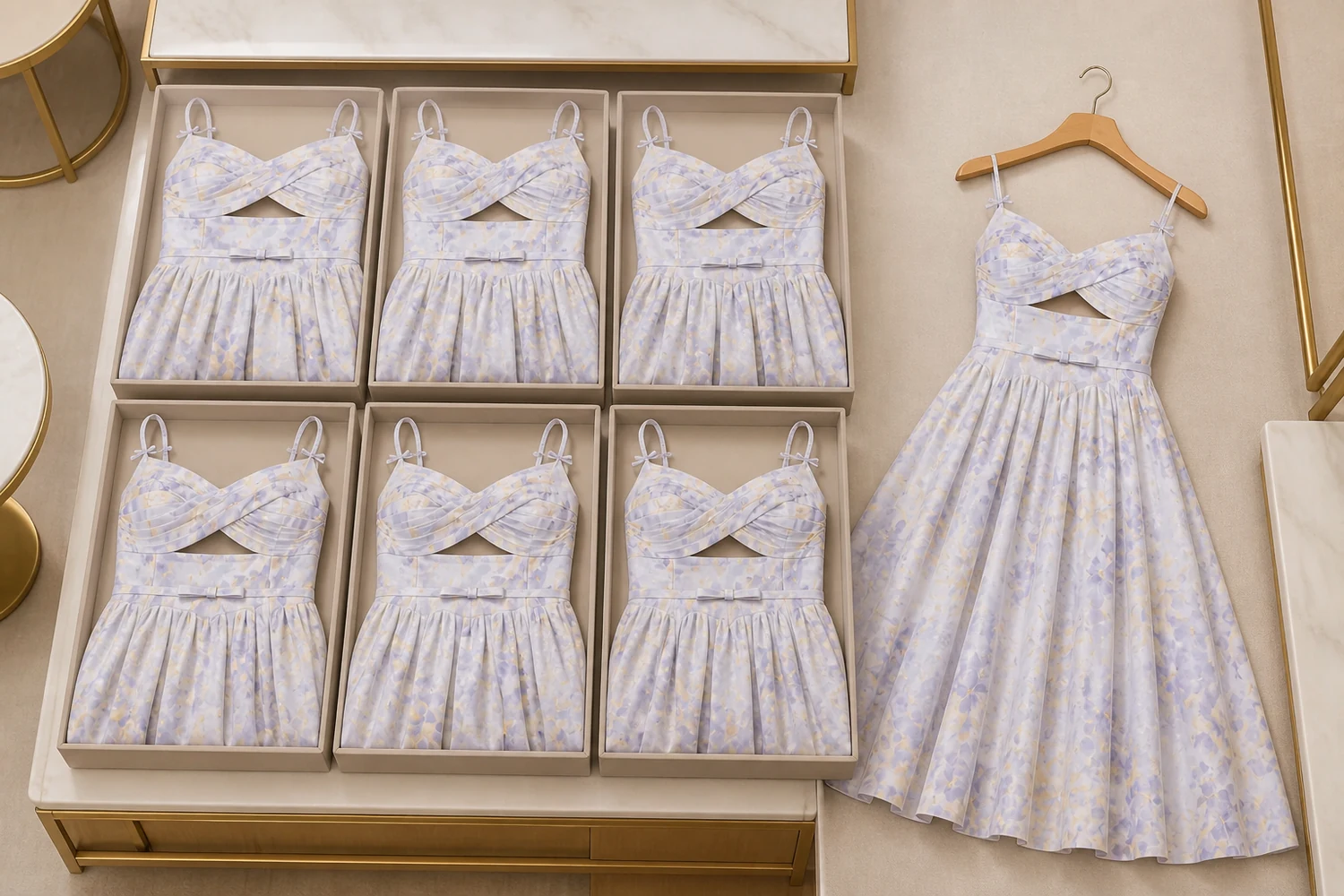
The source supports evening and occasion assortments, with spring weddings, garden parties, and afternoon tea named as styling contexts. Those signals can guide range planning, but each retailer should still align color, coverage, dress length, styling, price architecture, and campaign presentation with its own customer, climate, delivery window, and channel.
Build a focused assortment story
A floral print cutout midi dress can work as a statement item beside restrained layers, coordinated accessories, or complementary occasion separates, but the page does not verify those additional products. Merchandising teams should evaluate the dress itself for hanger appeal, photography consistency, size availability, return-risk questions, and the information customers need to understand the cutout and fit.
Care and label planning should also enter the development brief. For products sold in the United States, FTC guidance addresses fiber content, country of origin, responsible business identity, and care instructions. Requirements vary by market, so brands and importers should confirm their own obligations and maintain a reasonable basis for any care statement used on the finished garment.
Control Samples, Labels, and Repeat Orders
The page supports private label apparel sourcing through OEM/ODM service, customised samples, custom labels, custom tags, custom packaging bags, and custom grading. It declares a 100-piece minimum order per style per color, a sample time of 7–15 working days, and a 25–35-day lead time after sample approval. These are supplier declarations to confirm in the current quotation and production agreement.
Use one approved record across teams
A practical approval pack can connect the ATT13 model, approved sample, fabric reference, print standard, measurement method, graded chart, construction points, decoration reference, labels, tags, packaging, testing, delivery terms, and defect criteria. That record gives design, merchandising, technical, procurement, quality, and warehouse teams one controlled source during repeat ordering.
The product page contains two different packing descriptions, so neither should be treated as final without written confirmation. Buyers can resolve the exact bag, carton, folding method, protective material, assortment ratio, barcode, language, and shipping mark before bulk production. Receiving inspection should then compare the delivered units with the approved sample and purchase specification.
A pilot inspection can make those controls usable before the full order moves. The team can select representative units across the declared size range, record each measurement against the agreed method, compare print and shade under consistent lighting, inspect the twist and bow construction, and photograph accepted reference points. The same checklist can define what is repairable, what requires replacement, and who may authorize a deviation. Keeping the decision record with the lot and purchase order gives later replenishment teams evidence instead of relying on memory or a campaign photograph.
Frequently Asked Questions
What fabric composition is declared?
The selected page states printed fabric with a composition of 100% cotton. Buyers should still approve the production fabric through a physical reference and any performance tests required by their market and use case.
Which measurements are published?
The chart publishes garment length, bust, and waist values for XL, 2XL, and 3XL in centimeters and inches. The measurement method and required tolerances should be confirmed before the chart is used for fit or inspection.
Which design details need close inspection?
The twist bust, subtle under-bust cutout, slender bow straps, slim bow belt, pleated A-line skirt, watercolor floral pattern, and declared 3D flower decoration are the main source-backed details to carry into the sample checklist.
What sourcing support is listed?
The page lists customised samples, custom grading, OEM/ODM service, custom labels, custom tags, and custom packaging bags. Buyers should define the exact deliverables, approval gates, and current commercial terms in writing.
How should a repeat order be controlled?
A repeat order should reference the approved sample, fabric and print standards, measurements and tolerances, construction and decoration points, labeling, packaging, inspection plan, and authorized changes. Any material or pattern change should trigger review before release.
Discuss an ATT13 Sample and Collection Brief
Fashion brands, retailers, wholesalers, and distributors can review the verified floral print cutout midi dress evidence, then discuss target measurements, sample checkpoints, labels, tags, packaging, and current production terms.