

An off shoulder white cotton shirt dress should be reviewed for fabric declaration, fit measurements, neckline stability, lace placement, and sample performance.
Start With the Declared Product Evidence
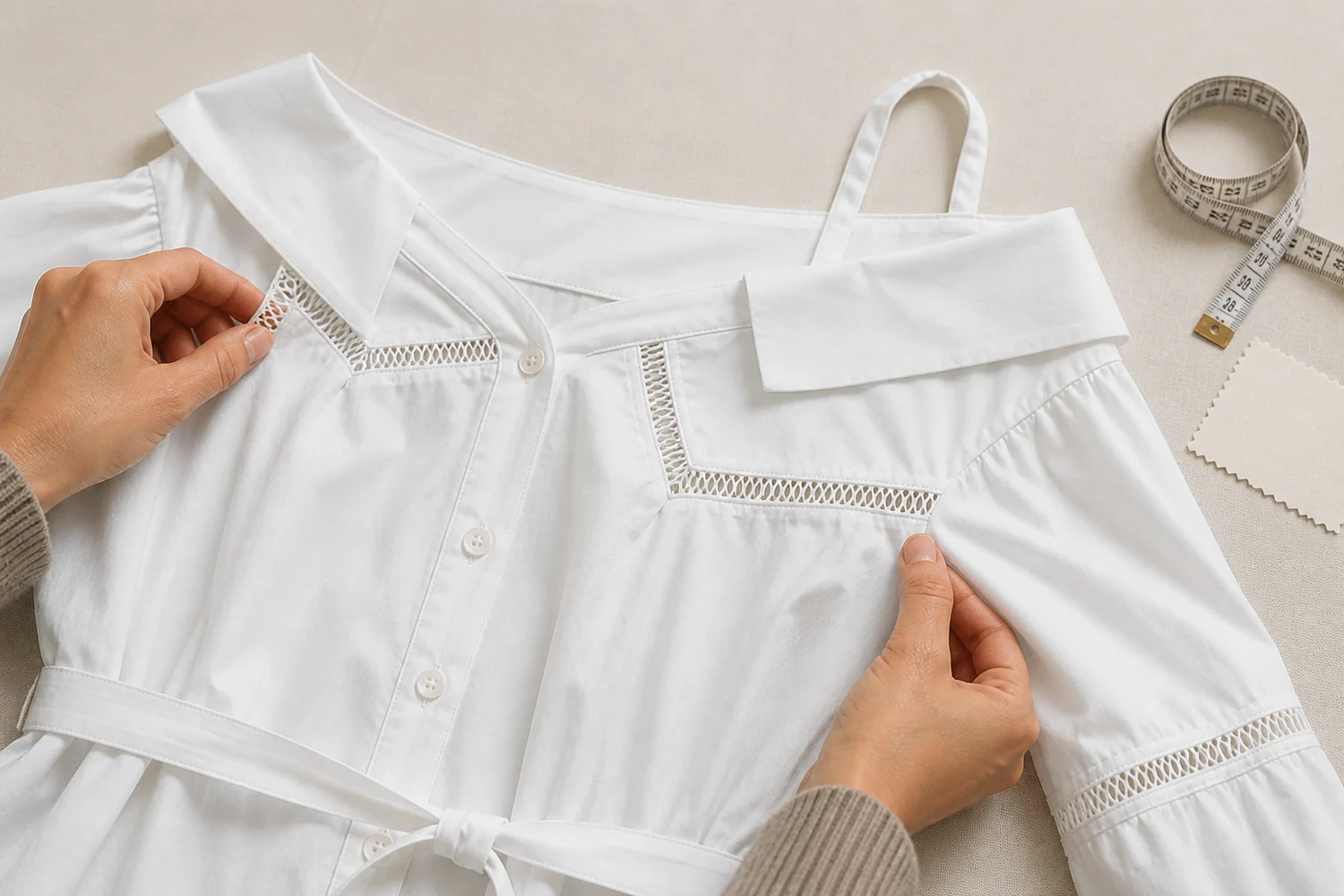
Model QZ8023 is presented as a white shirt dress in declared 100% cotton fabric for spring and summer. Its visible design combines a button front, an asymmetric off-shoulder collar, a thin support strap, long sleeves, geometric openwork lace inserts, and a matching fabric belt. These are the useful facts for a buyer's first review because each can be checked against the sample without relying on broad trend language.
The product page also publishes measurements for S, M, and L. The stated lengths are 81.5, 83, and 84.5 cm. Sleeve lengths are 51, 52, and 53 cm, while bust measurements are 95, 98, and 102 cm. A buyer should preserve the stated units and confirm how each point is measured.
Separate verified facts from review questions
The published values establish a comparison baseline, not a finished fit judgment. Ease, shoulder exposure, strap position, and collar behavior depend on body proportions and construction tolerances that are not fully described online. Buyers should therefore mark those items as sample questions. This distinction keeps a review traceable and prevents an attractive silhouette from being treated as proof of production consistency.
Translate the Design Into Fit Checkpoints
The neckline is the main fit risk and the main merchandising feature. An asymmetric off-shoulder collar must sit intentionally rather than collapse or migrate during movement. The thin support strap should help locate the garment without looking strained. On a sample, a reviewer can assess collar roll, strap tension, underarm coverage, sleeve attachment, button-placket alignment, and whether the waist tie shifts the bodice away from its intended line.
Use the chart as a control map
The published S–L chart supports an initial grade review. It shows length increments of 1.5 cm between listed sizes, sleeve increments of 1 cm, and bust increments of 3 cm then 4 cm. Those numbers should be checked against the physical sample, the brand's intended ease, and its own grading rules. The product page separately declares custom grading, so any extension beyond the listed chart should be documented rather than assumed.
- Confirm measurement method: align the supplier's points of measure with the buyer's technical pack.
- Test two styling states: review the garment with the waist tie cinched and worn loose.
- Move through wear positions: check collar, strap, sleeve, and hem behavior while sitting, reaching, and walking.
- Record tolerances: convert the approved sample into clear production limits for each critical point.

Inspect Cotton, Lace, and Construction Together
Cotton comfort can support a spring-summer proposition, but the fiber statement alone does not describe weight, opacity, hand feel, wrinkle response, shrinkage, or recovery. The product page declares 100% cotton and describes breathable fabric with structured drape. A buyer should confirm the composition label, test the actual fabric, and document care and dimensional-stability results before finalizing claims or customer-facing instructions.
Treat openwork as a construction system
The geometric lace inserts run across the bodice and sleeves, so their openness, alignment, seam joining, and resistance to distortion matter together. The review should include repeat placement from left to right, edge security, thread trimming, and how the insert behaves where it meets cotton fabric. Since white fabric and openwork can affect coverage, the sample should also be viewed under the lighting conditions expected in stores and photography.
| Decision factor | Verified evidence | Buyer implication |
|---|---|---|
| Fabric | Declared 100% cotton | Verify label, opacity, hand, care, and dimensional stability on the sample. |
| Neckline | Asymmetric off-shoulder collar with thin strap | Review stability, coverage, tension, and balance during movement. |
| Lace detail | Geometric openwork inserts on bodice and sleeves | Set standards for alignment, joining, openness, and thread finish. |
| Sizing | Published S–L chart and custom grading declaration | Confirm points of measure, ease, tolerances, and any requested grade extension. |
Match the Garment to an Assortment Role
For casual and everyday assortments, the garment works best as a distinctive white option rather than a generic basic. The off-shoulder line, ladder-like lace, long sleeves, and adjustable waist tie create multiple styling messages while retaining a familiar shirt-dress base. Merchandisers should test whether the short length, visible shoulder line, and openwork coverage match the target customer's expectations and the collection's delivery window.
Build content from approved sample evidence
A useful shoot list can show the front button line, asymmetric collar, strap, lace sections, sleeve finish, and two waist-tie states. Those views explain the product without inventing unverified features. The off shoulder white cotton shirt dress should be photographed against backgrounds that preserve the white fabric edge and reveal texture, since high-key styling can otherwise hide seam and openwork definition.
Assortment planning should also account for how customers will compare the garment with adjacent white dresses. The shirt construction offers familiarity, while the open shoulder and lace make the item more directional. Retail teams can decide whether to merchandise it with casual dresses, contemporary shirting, or occasion-led separates, then check that product descriptions, imagery, and size information all support the same expectation.
Plan Private Label Apparel Sourcing Controls
Private label apparel sourcing needs a written sequence from sample to production. FROM ATTITUDE declares support for customised samples, custom grading, labels, tags, and packaging bags. It also states a 100-piece MOQ per style per color, a sample time of 7–15 working days, and a production lead time of 25–35 days after sample approval. These are supplier declarations to confirm for the specific project, not promises that replace a purchase agreement.
Freeze the approved sample deliberately
The approval record should identify fabric composition, color standard, neckline position, strap length, lace placement, button spacing, belt dimensions, size measurements, workmanship criteria, labeling, and packaging. It should also state test methods and tolerances. An adjustable waist tie adds styling flexibility, but its width, length, attachment method, and position still require control so bulk units present consistently.
Pre-production review can then compare the sealed reference with the intended bulk materials and trims. Teams should check shade, fabric hand, lace geometry, buttons, sewing thread, and measurement records before authorizing volume. Inspection checkpoints can focus on the asymmetric neckline, strap attachment, openwork joining, placket alignment, cuff finish, belt construction, and hem. This sequence converts visual details into repeatable acceptance criteria.
FAQ for Buyer Evaluation
What fabric is declared for model QZ8023?
The product page declares cotton fabric with a composition of 100% cotton. A buyer should verify the production label and approved fabric against the physical sample and any required market-specific documentation.
Which measurements are published?
The page lists length, sleeve length, and bust for S, M, and L in centimeters and inches. The measurement method and intended ease should be aligned with the buyer's technical pack before approval.
How should the neckline be checked?
Review the asymmetric collar and support strap while the wearer stands, sits, reaches, and walks. Look for intentional exposure, stable placement, comfortable tension, and balanced interaction with the button placket.
What should be inspected in the lace panels?
Check repeat alignment, opening consistency, edge security, joining seams, loose threads, and distortion after handling. Confirm that opacity and coverage remain suitable for the intended customer and styling context.
Are custom development services declared?
Yes. The page declares OEM/ODM service, customised samples, custom grading, labels, tags, and packaging bags. Each request should still be specified and confirmed for the order.
Discuss the Review Plan
Brands, retailers, wholesalers, and distributors evaluating this garment can use the published evidence to prepare a focused sample brief. The brief can separate confirmed details from open questions, identify the wear and care tests required, and assign clear approval responsibilities before production planning. Teams can then discuss measurements, grading, trim control, labeling, and packaging for the off shoulder white cotton shirt dress.