
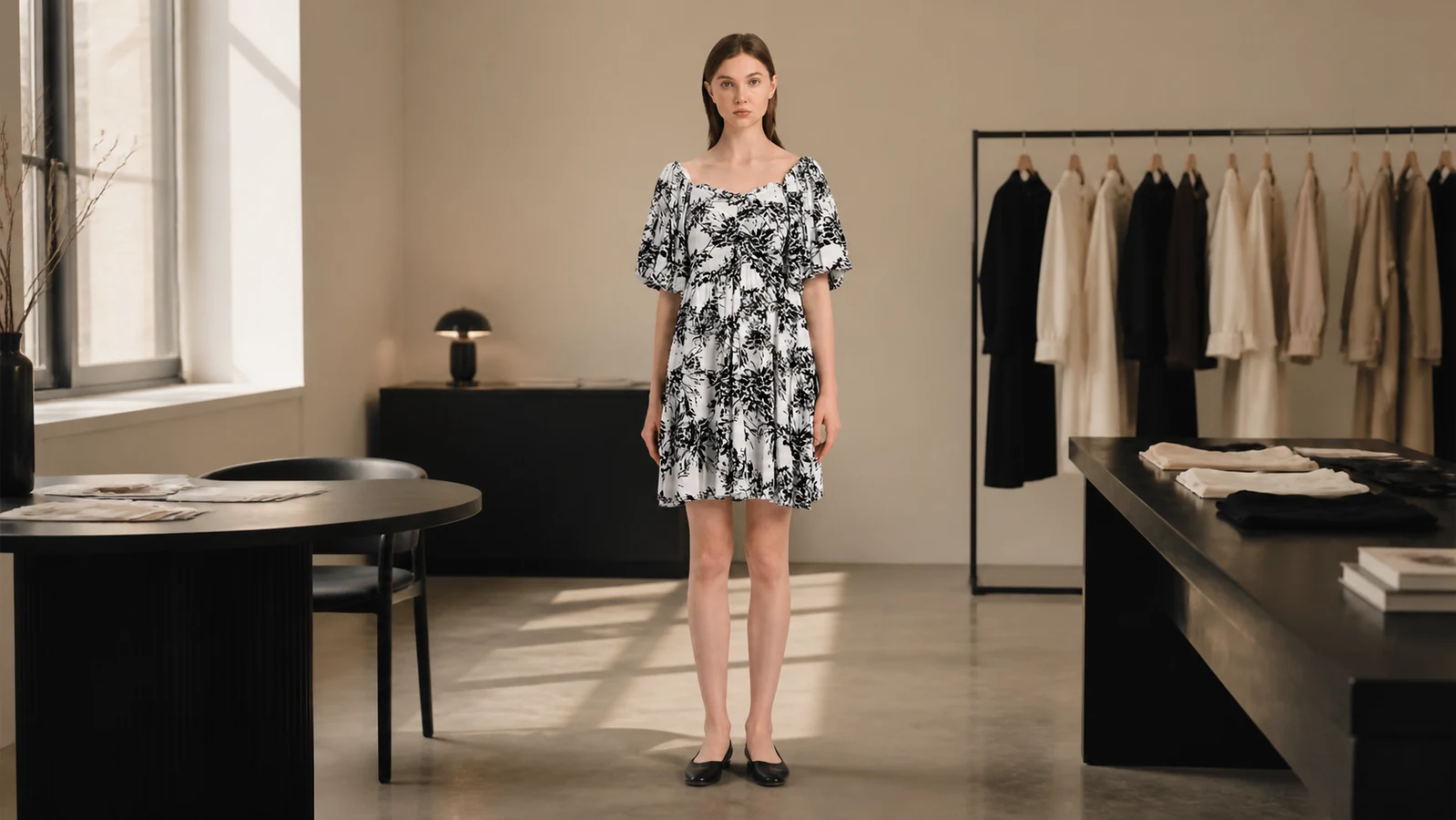
A vintage black white floral puff sleeve square neck dress should be reviewed through verified fabric, fit, sizing, silhouette, and sourcing evidence.
What Does the Verified Product Record Establish?
The selected SS21044 page establishes a defined product identity rather than a complete bulk-production approval. It declares a printed fabric with 100% polyester composition, a black-and-white botanical pattern, a gathered square neckline, relaxed puff sleeves, an empire-waist line, and a softly flared A-line skirt. The page positions the mini dress for spring and summer and presents front and back product views that buyers can use as visual reference points.
These facts help a buyer prepare a controlled sample review. They do not prove hand feel, stretch, opacity, print durability, seam quality, color tolerance, or final fit across a target population. Those characteristics require an agreed sample, measurement method, labeling brief, and approval record. The page's declared fiber composition should remain attached to the technical review because fiber information affects labeling, care planning, and merchandising communication in destination markets.
| Decision factor | Verified evidence | Buyer implication |
|---|---|---|
| Fabric declaration | 100% polyester printed fabric | Confirm the sample, label copy, care route, and destination-market requirements. |
| Visual identity | Black-and-white botanical print, square neck, puff sleeves | Approve print scale, placement, neckline balance, and sleeve volume against the reference. |
| Silhouette | Empire waist and flowy A-line mini skirt | Test movement, balance, hem behavior, and intended ease on the target fit model. |
| Development route | OEM/ODM and customised sample support | Define measurement, artwork, label, tag, and packaging requirements before sampling. |
How Should the Silhouette and Styling Direction Be Reviewed?
A vintage black white floral puff sleeve square neck concept is most useful when each visible feature is reviewed separately and then as one proportioned silhouette. The square neckline frames the upper body, the puff sleeves add volume, the empire waist raises the visual break, and the flared mini skirt provides movement. A sample review should confirm that these elements remain balanced from the front, side, and back without relying on the product image alone.
Separate Print Direction From Construction Approval
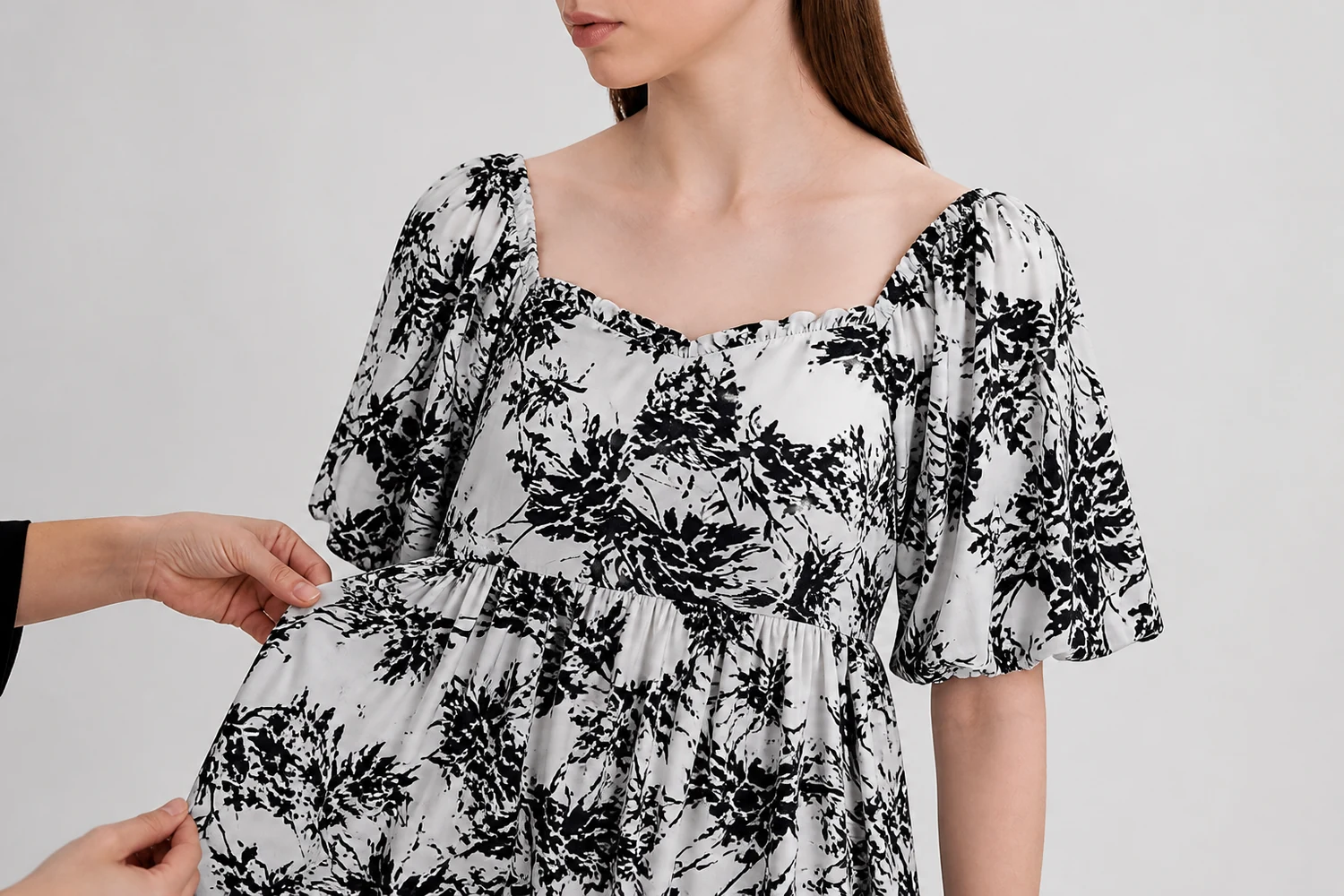
The monochrome botanical print can support casual and everyday assortments because it offers a defined visual story without introducing another color family. Buyers should still approve the actual strike-off or sample for scale, contrast, repeat, placement, and continuity across seams. The source page does not state placement tolerances, so those controls belong in the buyer's specification rather than in assumptions drawn from photography.
Test Occasion Positioning Through Styling
The same black-and-white direction can be considered for evening and occasion assortments when the retailer's styling, accessories, price architecture, and quality target support that use. This is a merchandising decision, not a performance claim. A review should compare the dress with adjacent items in the planned edit, check whether its mini length and sleeve volume fit the intended customer, and document any styling assumptions separately from the garment specification.
How Can Buyers Use the Published Size Data?
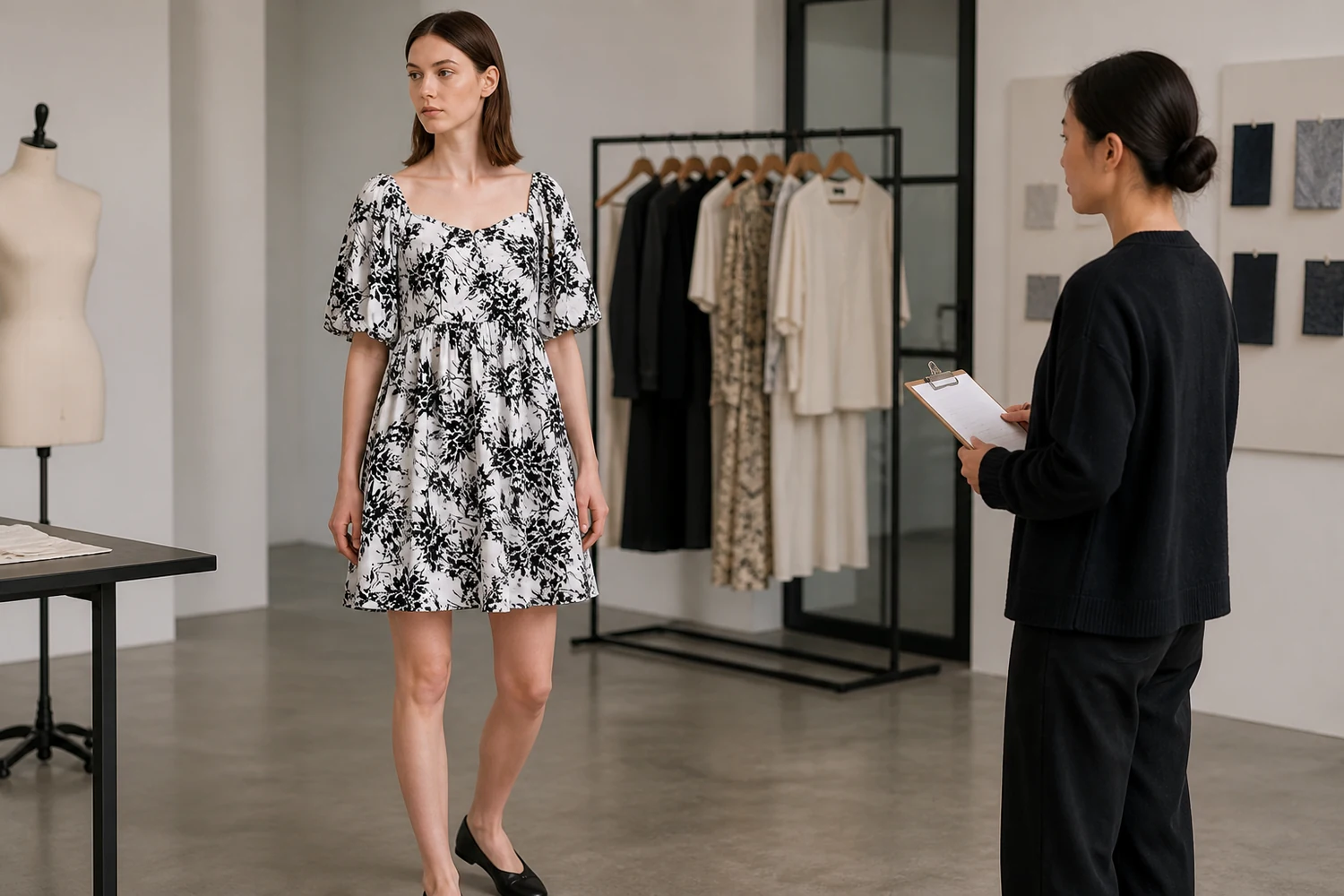
The page declares sizes S, M, L, and XL with custom grading available, but its detailed table publishes consistent length and bust pairs only for S through L. The listed dress lengths are 88 cm for S, 90 cm for M, and 92 cm for L. The listed bust measurements are 78 cm, 82 cm, and 86 cm. These values can start a review, yet they should not be treated as a complete grade rule or a guarantee of body fit.
Define Every Measurement Point
Before comparing sizes, the buyer should ask how length and bust are measured, whether the garment is laid flat, where the tape begins, and what tolerance applies. ISO and ASTM references illustrate why consistent terminology and body-measurement definitions matter in apparel development, but the buyer and supplier still need a style-specific method. A shared diagram prevents the same number from representing different physical points.
Resolve Missing and Conflicting Fields
The detailed table does not provide an XL row, and the sleeve-length conversions are internally inconsistent, so those figures should not guide approval. A disciplined request asks for corrected sleeve measurements, the complete XL specification, intended ease, waist position, hem sweep, and grade increments. The revised table should be approved before a fit sample is judged, otherwise the team may compare the physical garment against an unreliable baseline.
- Confirm method: identify measurement points, garment state, tools, and tolerance.
- Complete the chart: request the missing XL row and corrected sleeve data.
- Fit the sample: assess neckline stability, sleeve mobility, waist position, length, and movement.
- Record changes: update one controlled specification before the next sample round.
How Should Assortment and Sourcing Decisions Connect?
A vintage black white floral puff sleeve square neck style can move into sourcing only after the buyer connects its visual role to a controlled commercial brief. The page supports spring-summer positioning, yet workwear and tailored assortments would require a separate judgment about length, coverage, layering, movement, and the retailer's own customer expectations. The product record supports evaluation; it does not replace a channel-specific wear test.
Create a Sample Brief Before Negotiating Bulk Terms
For private label apparel sourcing, the page declares a 100-piece minimum per style per color, customised sample support, a sample time of 7–15 working days, and a lead time of 25–35 days after sample approval. These are planning inputs, not unconditional guarantees. The buyer should define when the sample clock starts, what constitutes approval, which revisions are included, and which materials or trims must be available before a bulk calendar is accepted.
Keep Branding and Packaging in the Approval Set
The page supports OEM/ODM service and lists custom labels, tags, and packaging bags. Each item should be specified through artwork, dimensions, material, placement, language, barcode needs, and approval responsibility. The page contains conflicting default packing descriptions, so a buyer should not infer the supplied packing format. A written packaging brief and approved mockup provide a safer basis for costing and production.
What Should Be Confirmed Before Bulk Approval?
Bulk approval should follow an evidence chain that connects the product page, corrected specification, approved sample, artwork, and commercial terms. The sample should be checked under the buyer's normal review conditions for print placement, neckline shape, sleeve balance, waist position, hem level, seam appearance, movement, and dimensional consistency. Any feature not stated on the page should be treated as an open requirement rather than as a promised characteristic.
- Lock product identity: model, fabric declaration, print reference, silhouette, and approved images.
- Lock measurements: corrected chart, measurement method, grade rules, and tolerances.
- Lock presentation: label, tag, packaging, artwork, barcode, and carton requirements.
- Lock process: sample milestones, approval authority, bulk timing, inspection points, and change control.
Destination-market labeling should be reviewed independently. For example, current United States FTC guidance requires covered textile products to disclose fiber content, country of origin, and the manufacturer or another responsible business identity. That general requirement does not establish compliance for this dress; it shows why buyers should align the page's fiber declaration with their own legal, label, and testing review before sale.
FAQ for Apparel Buyers
Is the dress made from a verified natural fiber?
No. The selected page declares 100% polyester printed fabric. A buyer should confirm that declaration on the approved sample and final label rather than infer fiber from the photographed drape.
Does the published chart cover every declared size?
No. The offer declares S through XL, while the detailed length and bust table covers S through L. The missing XL specification should be requested before grading or fit approval.
Can the sleeve measurements be used as supplied?
They should not be used without correction because the metric and inch entries are internally inconsistent. Buyers should request one corrected table with a defined measurement point and tolerance.
What customization is stated on the page?
The page lists OEM/ODM, customised samples, custom grading, custom labels, tags, and packaging bags. The exact artwork, material, dimensions, placement, cost, and approval route still need a written brief.
Do the listed timings guarantee delivery?
No. The page declares 7–15 working days for samples and 25–35 days after sample approval for lead time. Buyers should confirm scope, start points, material readiness, revision impact, and shipping separately.
Discuss Your SS21044 Development Review
Brands, retailers, wholesalers, and distributors can share target measurements, fit-model information, print controls, artwork, labeling, and packaging requirements through the SS21044 product page for a focused sample discussion.